About Me
Hi! I’m Matt, an undergraduate student at Haverford College
pursuing a degree in Astronomy and Physics, particularly interested
in computational astrophysics. This website shares my research, my
involvement in public observing, my experiences playing ultimate
frisbee, and some of the other interests and projects I pursue along
the way. Thanks for stopping by!
Education:
Haverford College, class of 2028
Research Interests:
Galaxies, Black Holes
Research
Select a project to read more about the research.
← All Research Projects
Modeling HI Global Profile
Haverford College
Advisor: Professor Karen Masters
HI 21 cm Single-Dish Observations of Galaxies: modeling the
HI global profile
HI global profiles, which measure integrated 21 cm emission as
a function of line-of-sight velocity, contain information about
both a galaxy’s rotation curve and its HI surface-density
distribution. In this project, we developed a physical model of
the global HI profile by combining rotation curves derived from
MaNGA observations with modeled radial HI surface-density
distributions. We investigated how variations in the central HI
distribution affect the resulting profile and compared our
modeled profiles with observations from the HI-MaNGA survey.
The model successfully reproduced the overall profile shapes
and flux ranges of the observed galaxies.
View Research Poster
← All Research Projects
Black-Hole Jet Disruption
Northwestern University CIERA
Advisor: Professor Alexander Tchekhovskoy
Understanding Jet Disruption of a Rapidly Spinning BH
by Misaligned Angular Momentum
Relativistic jets launched by accreting black holes can reshape
both the ambient medium and the accretion flow, but the mechanisms
responsible for transitions from the magnetically arrested disk
(MAD) to rocking accretion disk (RAD) remain uncertain. We
investigate, under the scope of angular momentum misaligned with
the black-hole spin, structures that could contribute to this
evolution. Using data from a 3D general relativistic
magnetohydrodynamic (3D GRMHD) simulation of a rapidly spinning
black hole, we derive the radial angular-momentum fluxes about
the Cartesian axes and analyze the magnitude of the y-direction
angular momentum flux, L_y, across 1375 simulation outputs. We
compare angular-momentum flux and density maps during the pre-MAD,
MAD, and RAD states. After the flow enters MAD, wave-like
disturbances appear near the central jet-launching region and
propagate outward through the ambient medium. Angular-momentum
structures also show a spatial correspondence with the low-density
filaments associated with magnetic-flux eruptions. However, the
visual analysis does not establish whether the jets, flux eruptions,
or both generate and transport the misaligned angular momentum.
Measuring the propagation properties of the disturbances and
calculating angular-momentum profiles for the
magnetic-flux-eruption filaments will be necessary to determine
which processes contribute to the transition out of MAD and the
subsequent disruption of the jets.
Simulation Movie
Y-direction angular-momentum flux and density from the
3D GRMHD simulation.
View Research Poster
← All Community Activities
Public Observing
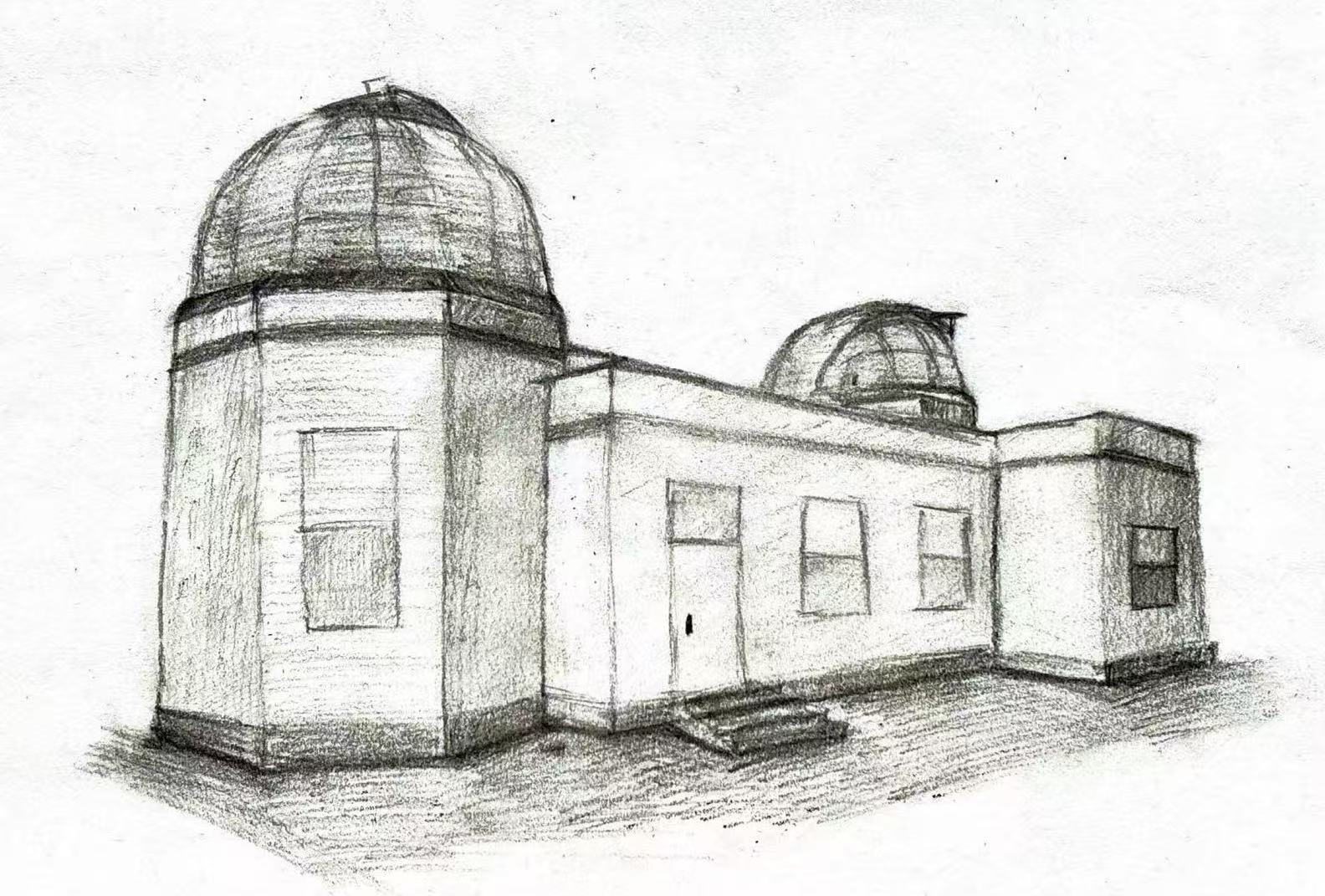
Strawbridge Observatory
Haverford College
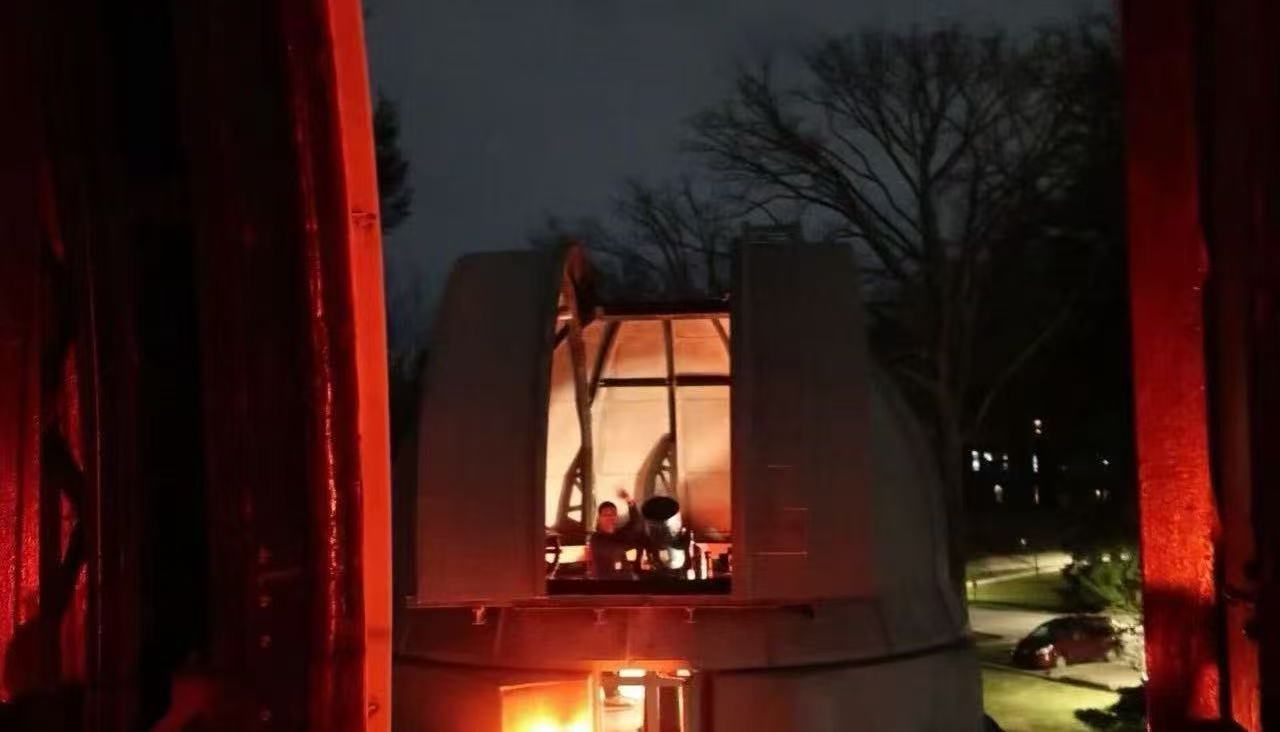
I am part of the Strawbridge Observatory Public Observing Team.
More details about public observing will be added here soon.
← All Community Activities
Ultimate Frisbee
Big Donkey Ultimate
Haverford College
I play ultimate frisbee with Big Donkey Ultimate. I will use
this page to share more about the team and my experiences
playing ultimate.
Contact
Email:
mtie@haverford.edu
Address:
370 Lancaster Ave, Haverford, PA, 19041